What tummy control means on an Ocean Blues swimsuit: ruching, lining and a high waist
The words on the tag promise a result; the cut can only do a job. What ruching, shirring, a double lining, a blouson body and a high waistband each do to the fabric, which Ocean Blues pieces use which, and how to tell from the description whether a piece has the construction the tag implies.
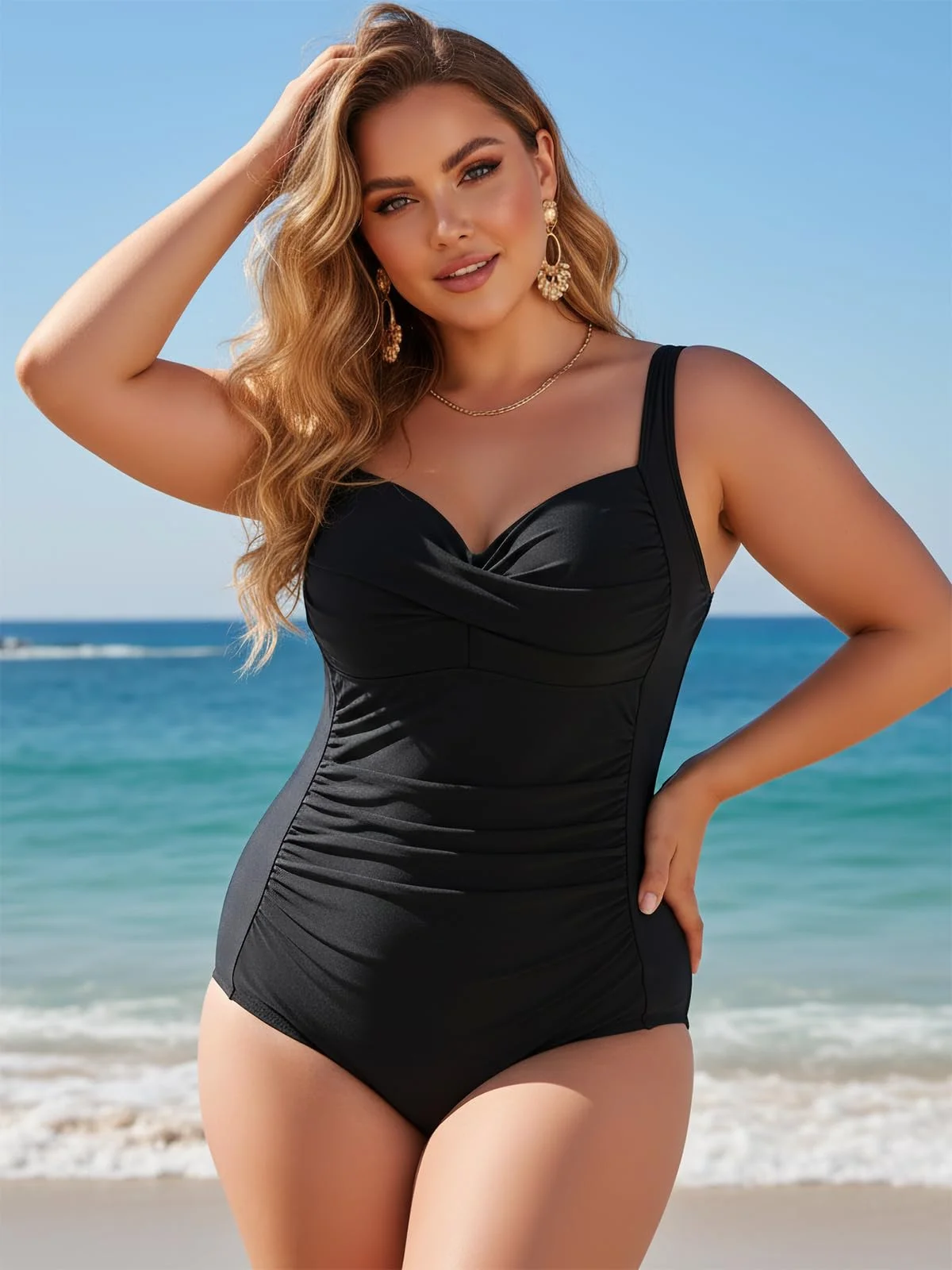
The phrase is on close to half the pieces in our catalogue, and it is on the tags of every swimwear brand you have ever bought. It promises a result. A swimsuit cannot deliver a result; it can only do a job with fabric, and there are about six jobs it can do. This is what each of them is, in construction terms, which Ocean Blues pieces use which, and what none of them can do. When you next read "tummy control" on a card, you will know what you are being sold.
The phrase, and the jobs behind it
Strip the promise off and what is left is a short list of things a pattern-cutter can do to the front of a swimsuit between the bust and the hip. She can gather the fabric on a seam, which is ruching. She can gather it across a whole panel, which is shirring. She can let it hang loose from a band, which is a blouson. She can double it, which is a lining. She can move the top edge of a bottom up to the navel, which is a high waist. And she can choose a fabric with more spandex in it, which is compression. Every "tummy control" tag on the market is one or more of those six, and the tag does not tell you which.
The description on each Ocean Blues piece does. The point here is to give you the words, so the description tells you what the tag will not.
Ruching: fabric gathered on a seam
Ruching is fabric drawn up along a line of stitching so that it falls in folds on either side of the seam. On a swimsuit the seam usually runs down the side, or down the centre front, or both, and the folds run across the body.
What it does is mechanical. Flat fabric shows every change in the surface under it, because there is one layer lying tight and the light catches each rise and fall. Folded fabric has its own surface, and the light catches the folds instead. Ruching also gives the front of a suit more fabric than it needs to lie flat. That is why a ruched piece forgives a letter either way at the waist: the folds close up on a smaller body and open out on a larger one.
Ocean Blues uses ruching on the twist-front tankini top, the ruched bandeau tankini and the wire-free twist tankini. It is also on the plus-size ruched one-piece, the plus-size plunge-neck one-piece, the ruched-side swim bottom and the bottom half of the high-waisted ruched bikini set. On the tankinis it runs down the body from the bust; on the bottoms it runs down each side seam.
What it does not do is change what is under the folds. It changes what the surface looks like and how much give the front has.
Shirring: fabric gathered across a panel
Shirring is ruching's cousin: rows of gathering across a panel rather than along one seam, so the whole area is textured rather than one line of it. It is what you see on the shirred bandeau one-piece, the shirred cut-out tankini, the cross-back V-neck one-piece and the front of the plus-size 3-inch board shorts.
It does the same job as ruching, with one difference, and one of the published comments on the plus-size 3-inch shorts puts it better than we could. The shirred front held more water and took longer to dry than the plain shorts the buyer compared it with, and it did not do what the tag implied. We print that because it is true of shirring in general. Gathered fabric is more fabric, more fabric holds more water, and the texture that hides a surface can also draw the eye to it. Shirring is a look first and a fit device second, and a buyer who wants the fit device without the look should read on to the blouson.
The blouson: fabric that hangs instead of lying
A blouson tankini top is cut with a band under the bust and a hem at the hip, and between the two the fabric is wider than the body, so it hangs. Nothing touches the front between band and hem. This is the one construction on the list that does not depend on the fabric lying against you at all. That is why it works for a reader who does not want anything gathered, tight or textured over the stomach.
The plus-size loose-fit tankini top is the plainest version, cut long in the torso so the hem stays at the hip when you sit. The blouson tankini top has a ruched hem, so the hanging body gathers back in at the bottom. The blouson tankini set and the high-neck loose-fit set are the same idea sold with boyshorts, and the set with the high neck adds mesh straps.
What the blouson cannot do is stay still in the water. Fabric that hangs floats, and a hem that floats rides up. The ruched hem on the blouson tankini top is there to slow that down. The long torso on the loose-fit top is there to give the hem further to travel before it clears the waistband of whatever is under it. If your day is mostly in the water rather than beside it, a ruched tankini will stay put where a blouson will not.
Lining: two layers instead of one
A lined swimsuit has a second layer of fabric sewn behind the first, either through the whole piece or through the front. Two layers do two things. They stop the piece going sheer when it is wet, which is the reason every white piece we make is lined. And they add a second surface that has to stretch before anything shows through, which is a small amount of what the compression fabrics do by other means.
Ocean Blues lines the ruched bandeau tankini through the whole piece and describes it as a double layer. The plus-size high-waisted bikini bottom has a full liner and a double layer of fabric at the front. The shirred cut-out tankini, the V-neck push-up tankini, the wire-free twist tankini and the long-sleeve moulded-cup swimsuit are fully lined. The board shorts with a brief sewn inside are lined in a different sense: the brief is a separate garment inside the short, not a second layer of the short.
A lining is the construction least visible from the outside and the one most worth checking on a light colourway. If the description says lined, the white will stay white in the pool.
The high waistband: where the edge sits
Everything above is about the fabric. A high waist is about where the fabric stops. A bottom whose top edge sits on the hip bone leaves the whole of the front between hip and navel uncovered; one whose edge sits above the navel covers it. That is the entire mechanism, and it is the one most people mean when they say tummy control, whether they know it or not.
The Ocean Blues high-waisted pieces are the high-waisted full-coverage bikini bottom, the plus-size high-waisted bottom and the high-waisted ruched bikini set. Then come the shorts and the skirt: the 8-inch pocket board shorts with their 2-inch waistband, the 3-inch high-waisted swim shorts with a 2.8-inch band, the mesh-lined swim skirt with a 2.4-inch band, and the plus-size 3-inch boyleg shorts. The width of the band matters as much as its height. A 2-inch band of elastic sits flat where a narrow one rolls, and the descriptions print the width where the piece was sold with it.
The trade is with the top. A high-waisted bottom under a bikini top leaves a band of skin between the two; under a tankini top it does not, because the tankini hem comes down to meet it. That is why the pairings in our activity guide put high-waisted bottoms under tankinis.
Compression: what the fabric itself does
Two Ocean Blues pieces describe the fabric rather than the cut. The mid-rise high-leg bikini bottom is a nylon and spandex blend with what the description calls light compression. The moulded-cup one-piece has a front panel of lightly compressive fabric behind its ruching. The twist-front tankini describes panels at the front for the same purpose.
Compression is spandex doing its job: a fabric with more of it, or a second panel of it, pulls back harder when it is stretched. On a swimsuit that means the front lies flatter against whatever is under it and moves less in the water. It is the one construction on the list that does something to the body rather than to the surface. It is also the hardest to size, because a compressive fabric a letter too small is not a firm fit. It is a tourniquet. The description of the high-leg bottom says to size up if you are between letters, and that is the reason.
Which piece uses which
| Construction | Ocean Blues pieces that use it | What it does to the fabric |
|---|---|---|
| Ruching | Twist-front tankini, ruched bandeau tankini, wire-free twist tankini, ruched one-pieces, ruched-side bottom, ruched bikini set | Folds along a seam; more give at the waist |
| Shirring | Shirred bandeau one-piece, shirred cut-out tankini, cross-back V-neck one-piece, plus-size 3-inch shorts | Texture across a panel; holds more water |
| Blouson | Loose-fit plus tankini, blouson tankini top, blouson set, high-neck set | Hangs clear of the front; floats in water |
| Lining | Ruched bandeau tankini, plus high-waisted bottom, the fully lined tankinis and long-sleeve suits | Two layers; stays opaque wet |
| High waist | High-waisted bottoms, the ruched set, all board shorts and the swim skirt | Moves the edge above the navel |
| Compression | Mid-rise high-leg bottom, moulded-cup one-piece, twist-front tankini panels | Fabric pulls back harder |
Most pieces use two of the six at once. The plus-size ruched one-piece is ruching plus a full-coverage cut. The 8-inch board shorts are a high waist plus a lined brief. The ruched bandeau tankini is ruching plus a double lining plus a hem that reaches a high waist. Read the description for the words, not the tag for the promise.
What none of them do
None of the six changes what is under the fabric. A swimsuit is a surface, and the six constructions change the surface: how it folds, how much of it there is, how far up it goes, how hard it pulls. That is all a garment can do, and it is all we will say one does. If a description on this site ever seems to promise more than that, the fault is in the sentence and we would rather know.
There is also nothing wrong with wanting none of them. Half of our catalogue does not carry the phrase. The plain pieces, the string-tie triangle top, the side cut-out bottom, the high-cut low-back one-piece, are plain by design, and there is nothing to read into that.
How to choose between them
If you want fabric that does not touch the front at all, choose a blouson, and accept that it floats. If you want to swim, choose ruching or shirring, and if you have to pick between them, ruching dries faster. If the piece is white or pale, check that the description says lined. If what you want covered is the front between hip and navel, the only construction that does that is a high waist. The width of the band decides whether it stays there. And if you want the fabric to pull back, look for the word compression in the description, size by the chart rather than by habit, and go up when in doubt.
The label sewn into the piece, by the way, will not use any of these words. Under US labelling rules it has to tell you the fibre, the country and the care, and nothing about the cut. The cut is in the description, which is where we have put it.
More of this sort of thing is in Swim Notes, and the people at Ocean Blues keeps the whole range one click away on the front page.